
Legacy of a Book
The guidance of God

This past Sunday, Tim was up front.
Tim is a retired pastor, father of one of our three regular pastors, and the man who leads our midweek home fellowship group. He preaches maybe once every six to eight weeks, and when he does it’s worth paying attention.
One of the points Tim made was worth sitting with: the Holy Spirit is always at work in the lives of believers and unbelievers alike, so the job of a faithful disciple is to get better at noticing what God is already doing so he can join Him there.
Toward the end he mentioned a name. I had to smile as I nodded involuntarily. That name has real history with me.
Rewind to mid-2006.
I’m eighteen months into a Masters degree at Grace Theological College in Manurewa, South Auckland. One day my main professor beckons me over at the end of his Systematic Theology class and informs me there’s a conference happening in two weeks time. He’s going and recommends I go along too. Then he places a book in my hand while saying I’ll get more out of the conference if I’ve read it beforehand.
The book was Experiencing God. A very interesting read!
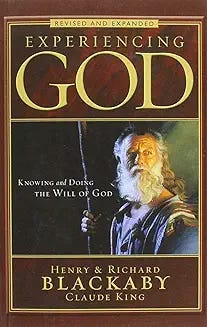
It wasn’t the feeling of learning something entirely new. Henry & Richard described what I’d already been living without my having language for it. What I’ve been writing about on this Substack; the still small voice at a roundabout, the compulsion to come straight home from Tanzania that made no sense until after I’d adjusted my travel plans, the free room two hundred yards from the college that appeared on orientation morning, all of it the kind of thing Blackaby was describing. God inviting people to join what He was already doing.
Not a formula or system. A relationship with a living Person who moves differently each time, who can’t be reduced to a method, who asks for trust rather than technique.
What Blackaby named clearly, and what I found genuinely helpful, was the idea of assignments. Sometimes a thing that God clearly started, a ministry, a role, a season of work, simply runs its course and is done. The fruit stops coming. The energy drains away.
Instead of reading those signs honestly, too many believers grip harder. Their identity has become tangled up with the thing continuing, so they push and push, burning themselves out trying to sustain something the Spirit has quietly moved on from. Blackaby’s counsel was blunt: be willing to pack it up, surrender it, and ask God what’s next. The adventure is usually on the other side of such surrender.
Seen this in my own life already. Leaving dairy farming. Leaving Tanzania after nine years. Each involved releasing something I could have gripped but letting go made room for what God wanted to do with, or for, me next.
Early August 2006, my professor Andrew Young and I drove over to the conference together.
Richard, the eldest son of Henry Blackaby, turned out to be exactly what I hadn’t quite expected from a man of his profile. We arrived early while he was in the auditorium doing last minute note prep. He stopped, came over, sat down with us, and gave us nearly ten minutes of genuine, unhurried conversation while the other attendees were filing in. A bloke genuinely interested in you and what God was doing in your life.
His message confirmed that this experiencing God idea was not a niche concept. Nothing peculiar to my own unique biography but how God had been doing it since Abraham packed his tent sans knowing where he was going. Now it had been named for my generation.
Three weeks later I was sitting in the Reformed Church of Hamilton reading the monthly church magazine.
There was an article reprinted from an American sister church’s publication. A professor was teaching theology at a small Reformed college being established in Uganda. He described the work warmly and toward the end of the article mentioned what they needed most. Not another theologian. Someone practical to do and/or oversee things like vehicle maintenance, building projects, agricultural extension work with subsistence farmers, financial mentoring for the local church elders learning to manage funds wisely.
Interesting.
Nine years advising the staff and/or managing the operations of three different enterprises in Tanzania. I didn’t need to squint to see the fit.
I said nothing to my church because I didn’t want to raise expectations about something that might come to nothing. This was a conversation to have quietly first. I tracked down the American professors contact details and emailed him within days. He replied and we kept corresponding through October and November. By then he was inviting me to come and see the work for myself before either of us committed to anything further.
That was when I approached my church elders to say that perhaps I might be God’s way of providing their American sister churches need for a missionary deacon. They were supportive and I flew to Uganda for the whole of January 2007.
What I saw was convincing but I took their advice and waited until I’d completed my studies before formally applying for the position in February 2008. The Americans accepted me for a one year trial term and, after the wheels took the time to turn that they do between such organizations, I arrived in Mbale in early October 2008.
Ten days later I met Eden.
She had been in Uganda about three months, teaching the homeschooled children of the missionary families stationed up in the Karamoja region.
We slowly got to know each other over the months that followed, and then more quickly during an unforeseen trip to Tanzania in January 2009. By the time she returned to the United States in March I’d introduced her to the concepts espoused by Experiencing God.
Given everything that was complicated about our situation; a protective American family who had not signed up for their daughter to return from Africa romantically interested in an older, previously married, man from another country, the book turned out to matter way more than I could have ever anticipated reading it three years earlier.
It gave us both a framework for navigating what God was doing in the face of considerable pressure to quit. When you’ve learned to look and listen for what God is already doing rather than just reacting to what people around you are saying, it changes what you’re able to hold onto and persevere through.
But I’m getting ahead of myself. That whole saga contains many post worthy episodes yet to be written.
October 2009. I'm in Christchurch for an international missions conference of Reformed Churches held every four years. Around two hundred representatives from across the western world and beyond. I was there mainly to spend time with the director of the American missions committee I'd be formally serving under, a man I'd briefly met twice already, once in Uganda and once in the USA, but both of these times had been cut way shorter than my mission colleagues and I had hoped for.
He'd suggested I attend but I got less than five minutes alone with him the whole conference. We also had a meeting with the elders of a Christchurch Reformed church keen to support me financially. He excused himself from that after fifteen minutes too. The elders were gracious about it and we talked at length without him.
Later that evening an elder called me. He hadn’t been able to attend the meeting due to a prior work commitment. Would I come for dinner the following evening? I had plans to visit my sister and her family on their farm near Mayfield in mid-Canterbury but something seemed right about his request.
I said yes. It would only delay my arrival at my sisters farm by a few hours.
I didn’t expect anything beyond a pleasant meal with a hospitable older couple. What happened instead was one of those conversations that ends somewhere you’d never have anticipated. Somewhere over the meal we found each other out.
They were Blackaby people.
It emerged gradually like things do when you’re being honest rather than performing. This guy and his gal loved their church deeply and knew God had placed them there. They weren’t going anywhere but they carried a loneliness I recognized.
The way they experienced God’s guidance, His active voice, the sense of being moved and directed and spoken to in ways that went beyond the printed Word of God, wasn’t the accepted currency in both our congregations.
Reformed theology done well is a serious and beautiful thing. But when it insists on cessationism it leaves people who have genuinely heard God speak feeling quietly strange, as though their experience is either an embarrassment to others or a heretical delusion.
We connected bigtime on Africa too. They’d immigrated to New Zealand from South Africa only a decade or so earlier. We talked well into the night covering both of our commonalities.
I drove away profoundly encouraged and more hopeful about my role in the Uganda mission than I had been feeling. Receiving mere minutes of my American bosses attention during my few days in Christchurch had seemed odd but it was solidifying what I’d sensed the very first time we’d interacted. That he was far more heavily task-focused, and therefore process and procedure oriented, than any leader of any organization I’d worked for thus far.
All that being so, my faithful God was still on the move arranging me dinner with strangers who turned out to be spiritual kin of the most wonderful kind. People who had been quietly living the same way of walking with God within a context that didn’t quite have room for it.
Henry Blackaby died in August 2023 at the age of eighty-eight. His sons and daughters carry the work forward. Richard still speaks and writes. Experiencing God is still in print, still finding people at the right moment. It’s not the only helpful book on this topic but it was the first one God put in front of me. Thank you Dr. Andrew Young!
Eden and I have pressed copies of it into the hands of certain friends and family members over the years. Usually people unsure about, or struggling with, a transition. Almost without exception it has helped them because it gives a way of asking better questions. It teaches you to look for, and listen to, what God is already doing, and then decide whether you’re willing to join Him in your new assignment.
Which is more or less one of the keys Pastor Tim was teaching us about this past Sunday.
Some threads may be long but by the faithfulness of God they hold strong.
What a wonderful testimony of how God works! I had read this book years ago but after reading this I may need to get it out and read it again! Thank you! 🙏